
Where Did That Number Come From? Why Measuring the Total Isn’t Enough
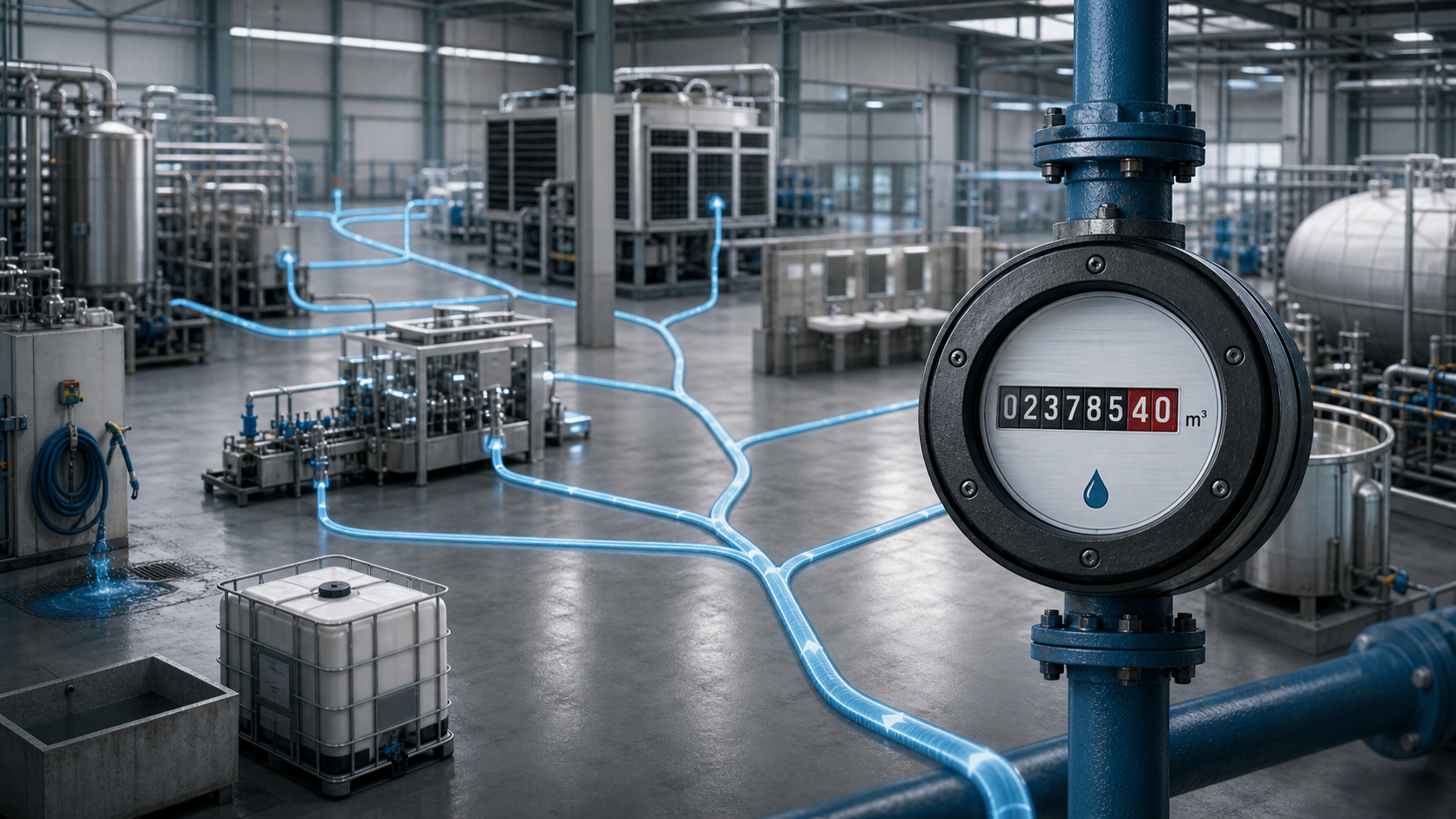
In the world of industrial operations, accuracy is often mistaken for utility. When a quarterly water invoice arrives from a registered utility provider, the number on the page is rarely questioned. It is, after all, a certified measurement from a primary revenue meter. However, for the plant manager or the sustainability lead, that number represents a paradox: it is perfectly accurate, yet operationally useless.
At AsTrack, we call this the Aggregate Blind Spot. While the total tells you how much you owe, it fails to tell you how you are actually performing.
The Anatomy of an Aggregate Number
Imagine a standard manufacturing facility. The main meter records every drop of water that enters the property. That single figure is the sum of a complex ecosystem of consumption points:
- Production Lines: High-volume usage for core manufacturing.
- Cooling Towers: Evaporative loss and constant replenishment.
- Cleaning Processes: Periodic spikes for sanitation and wash-downs.
- Amenities: Domestic use in canteens and locker rooms.
- The Unknown: Slow-drip leaks, stuck valves, and system inefficiencies.
When these flows are collapsed into a single total, their individual signatures vanish. You are left with a macro-view of the facility that masks micro-failures.
Accuracy vs. Actionability
It is entirely possible for a meter to be 99.9% accurate while providing 0% actionable insight. If your water consumption increases by 15% this quarter, an aggregate invoice cannot tell you why.
Was the increase due to a ramp-up in production? A failure in the cooling system’s float valve? Or perhaps a subterranean pipe burst that has been weeping into the foundation for three months? Without sub-metering and granular tracking, these questions remain unanswered. You are forced to manage by intuition rather than evidence.
The Cost of Staying at the Surface
Operating with only "total" numbers introduces three primary risks to an enterprise:
1. The Invisibility of Inefficiency
When consumption is bundled, inefficient equipment can hide behind efficient systems. A specific production line might be using twice the water it was designed for, but if the rest of the plant is performing well, that waste is absorbed into the average.
2. The Delayed Response
Aggregate reporting is usually retrospective. By the time you receive a quarterly bill showing a spike, the event that caused it—a leak or a process error—has likely been occurring for 90 days. That is three months of wasted resources and unnecessary costs.
3. Baseline Drift
Without measuring specific points, it is impossible to establish what "normal" looks like for different operational states. You cannot determine if you are operating within tolerance if you don't know the tolerance for each individual sub-system.
Intelligent Infrastructure: Beyond the Total
The transition from reactive to proactive management requires breaking the total down into its component parts. This is where AsTrack’s philosophy of Intelligent Infrastructure comes into play.
By implementing sub-metering and integrating those data points into a centralized monitoring platform, the "Total" becomes a starting point rather than the final word. You gain the ability to:
- Isolate Variance: Immediately identify which specific line or system is exceeding its historical baseline.
- Benchmark Performance: Compare different shifts or production runs to see which processes are truly optimized.
- Validate Savings: If you invest in a new water-recycling system, you can see its direct impact on the sub-meter, rather than hoping it shows up as a small dent in the main invoice.
Conclusion
Measuring the total is a financial necessity, but measuring the components is an operational mandate. An accurate invoice is not a diagnostic tool; it is merely a receipt. To truly drive efficiency and sustainability, organizations must move beyond the aggregate and start asking the harder question: "Where, exactly, did that number come from?"
Only when you measure the points can you master the total. That is the essence of Intelligent Infrastructure.
Frequently asked questions
- What is the Aggregate Blind Spot in industrial operations?
- The Aggregate Blind Spot occurs when a single total measurement from a primary meter masks individual consumption signatures. While the total number is accurate for billing, it fails to show how specific systems like production lines or cooling towers are performing.
- Why is aggregate reporting considered a risk for businesses?
- Operating with only total numbers creates the invisibility of inefficiency, where wasteful equipment hides behind efficient systems. It also leads to delayed responses because spikes are often discovered months later on a quarterly bill.
- How does sub-metering improve operational efficiency?
- Sub-metering allows managers to isolate variance by identifying which specific lines exceed their baselines and enables benchmarking between different shifts. It provides the granular data needed to validate savings from new equipment or processes.
- What is the difference between accuracy and actionability in metering?
- A meter can be 99.9% accurate but provide 0% actionable insight if it cannot explain why consumption increased. Actionability requires breaking the total down into component parts to identify leaks, process errors, or production spikes.