
Why Most Commercial Buildings Already Have the Data They Need
The Visibility Gap in Building Management
For facilities managers and building engineers, the primary challenge in the modern era isn't a lack of information; it is the accessibility of it. Most commercial buildings are already rich with operational data produced by water meters, pressure gauges, flow sensors, and gas indicators. However, this data is often locked inside analogue hardware, requiring manual walk-throughs to capture. This visibility gap creates a reactive environment where issues are discovered only after failures occur.
The Intelligence Hidden in Plain Sight
Legacy infrastructure is remarkably resilient. A mechanical pressure gauge or a robust water meter can function for decades. These assets are already recording critical trends regarding energy consumption, mechanical health, and fluid dynamics. The intelligence is present, but it lacks a digital interface. Until recently, the only way to digitise this information was through expensive 'rip and replace' cycles - swapping functional analogue assets for IoT-connected smart meters which is often cost-prohibitive and operationally disruptive.
The Real Cost of Manual Monitoring
Many organisations rely on human inspections to monitor their existing infrastructure. While these roles are vital, manual data collection introduces three significant risks:
- Temporal Gaps: A reading taken once a day or once a week cannot detect a leak or an electrical spike occurring between checks.
- Human Error: Transcription errors or missed readings can lead to inaccurate baseline data.
- Safety and Efficiency: Sending engineers into remote or hazardous areas solely to read a dial is a poor use of skilled labor.
Unlocking Data Without Replacement
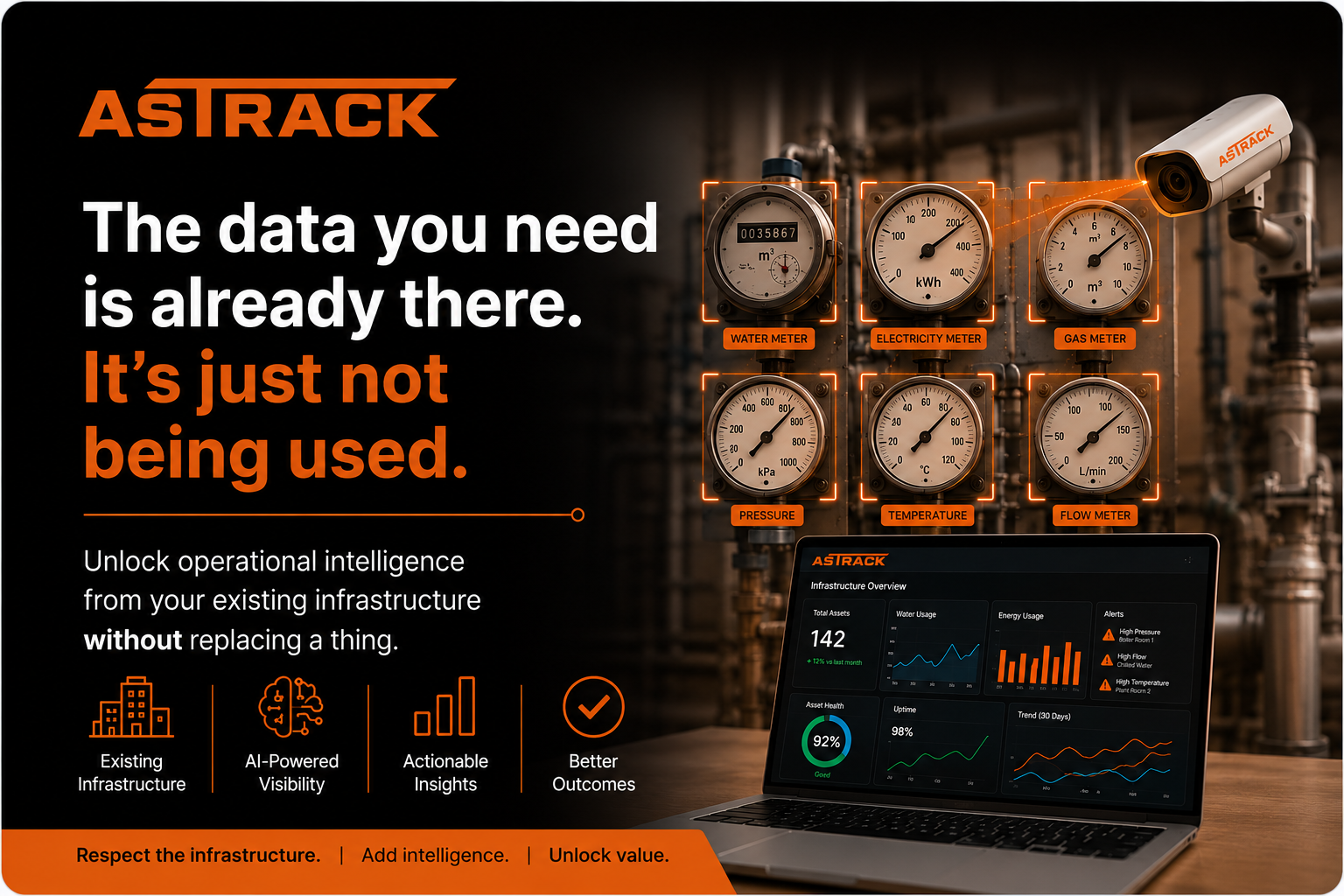
Modern advancements in computer vision and AI have changed the paradigm. Instead of replacing a working flow meter, organisations can now use non-invasive optical sensors to 'read' the gauge exactly as a human would.
Converting Images to Actionable Intelligence
Through AI-driven edge computing, images of analogue dials are converted into precise digital data points. This information is then pushed to centralized dashboards, providing:
- Real-time Trending: Visualising fluctuations in pressure or consumption over time.
- Automated Alerts: Instant notification when a gauge exceeds a set threshold.
- Legacy Integration: Feeding data from old equipment directly into modern Building Management Systems (BMS).
Strategic Benefits Across Industries
This approach to monitoring existing infrastructure offers significant advantages for specialised sectors:
- Commercial Buildings and Hotels: Precise water and gas monitoring for ESG reporting and cost allocation.
- Hospitals: Ensuring oxygen pressure levels and HVAC performance remain within strict compliance margins.
- Manufacturing and Utilities: Detecting early signs of mechanical fatigue through pressure fluctuations, enabling true predictive maintenance.
By leveraging the data they already have, asset managers can shift from reactive repairs to a reliability-centered maintenance (RCM) strategy. This not only extends the lifespan of the equipment but also ensures a robust audit trail for compliance and energy management.
Conclusion: The Future is Intelligent Infrastructure
The path to a smarter building does not require a complete overhaul of its foundations. The future of intelligent infrastructure lies in bridging the gap between historical reliability and modern digital insights. Organisations already own the sensors and metrics they need to optimise their operations; they simply require the tools to listen to what their equipment is already saying. By utilising AI to unlock existing infrastructure, AsTrack helps facilities transform legacy assets into a unified, intelligent network without the need for replacement.
Frequently Asked Questions
- What is existing infrastructure monitoring? It is the process of using technology to capture data from legacy assets without replacing them.
- How does AI read analogue gauges? Using computer vision, AI identifies the position of a needle or digits on a display and converts it to a numerical value.
- Do I need to replace my old water meters? No, optical sensors can be retrofitted to capture data from existing meters.
- Can this help with ESG reporting? Yes, by providing accurate, real-time data on resource consumption.
- What is predictive maintenance? Using data trends to predict when an asset might fail before it actually does.
- Is computer vision secure? Yes, most systems process data at the edge, meaning only the reading, not the image, is transmitted.
- Does this work in low light? Advanced sensors include localised lighting or infrared capabilities for dark environments.
- Can it monitor tank levels? Yes, by reading external sight glasses or level indicators.
- How long does installation take? Non-invasive retrofits typically take minutes per device.
- What is 'Intelligent Infrastructure'? The integration of AI and data analytics into physical assets to improve operational outcomes.
Ready to see what your building is telling you? Book an Infrastructure Intelligence Assessment with AsTrack today.